Letters OF Accolades for J.H. Murphy

Eastman Kodak Company - 1933
1933 Eastman Kodak built J.H. Murphy a studio in Rochester, NY. The letter here signed by the famous Waldo B. Potter, Director of Advertising Eastman Kodak. He also played a major role in Kodak's Colorama Exhibition and served as VP of Advertising.
Also of note is Edwin B. Luce whose name appears on the letter. J.H. Murphy was a student of and worked with Edwin Bradbury Luce (1881–1938) for seventeen years. Luce was recognized as a pioneer photographer of commercial and industrial photography and established one of the nation’s most successful and oldest commercial photography studios.
"we are very glad that you are joining us ... and are looking forward to your efforts with keen anticipation."

Chicago's Museum of Science and Industry - 1933
The Museum of Science and Industry in Chicago in 1933 (now the Griffin Museum of Science and Industry) displayed works by J.H. Murphy. The letter signed by Otto Theo Kreusser, director of the museum from 1931-1936.
"we are happy to make your excellent photographs a part of our permanent collection ... such active support as yours is invaluable in maintaining the high standards of our Museum."

Chicago Camera Club - 1933
The organization was listed in the "International Salon of Photography" catalogue for the "Century of Progress International Exposition" in Chicago. The catalogue promoted the event and highlighted the evolution of photography from its early mechanical and chemical days to its modern, versatile role in art, science, and everyday life. JH Murphy's works were selected by the organization for display at the Chicago Museum of Science and Industry, World's Fair (1933), and elsewhere. The letter signed by George Henry High who was the influential role in curating high-quality photographs for major institutions.
"your prints are among those selected ... The Chicago Camera Club feels that this request reflects credit and honor ... we know of no better place in the world today than the [Chicago} Museum of Science and Industry"

Women's Labor Department Washington D.C. - 1943
JH Murphy contributed to the women's war effort during World War II. His works displayed at the Women's Bureau and other Labor Departments. The Women's Bureau, an agency within the Department of Labor, was founded on June 5, 1920. It is the only federal agency mandated to represent the needs of wage-earning women in the public policy process. It's the place that that gave birth to Rosie the Riveter. They wrote,
"they [photographs] have been widely displayed in Washington and we have had requests from three important Bureaus for individual sets ... The Women's Bureau thinks so highly of them"
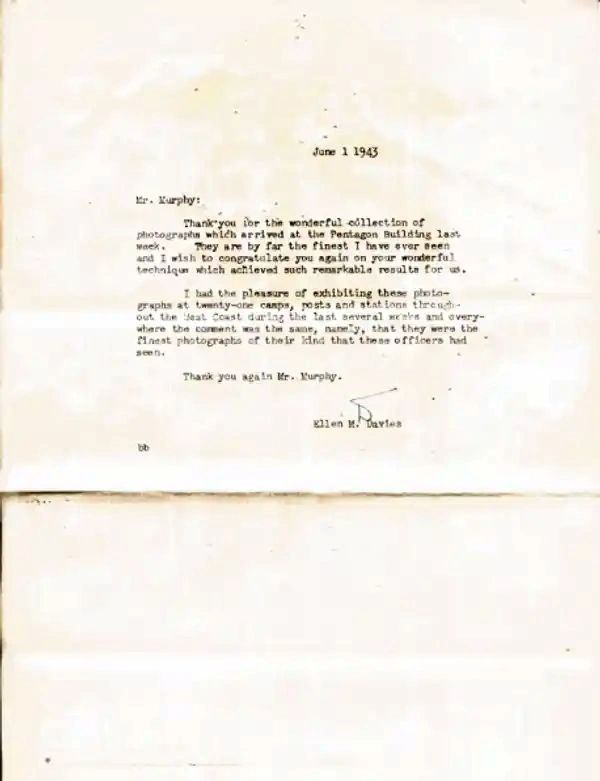
Pentagon - 1943
Artwork of JH Murphy also appeared in The Pentagon and other office buildings in Washington D.C. during World War II. Constructed during 1941–43, the Pentagon was intended to bring together the offices of the War Department. Ellen M. Davies wrote,
"I had the pleasure of exhibiting these photographs at twenty-one camps, posts and stations throughout the West Coast during the last several years and everywhere the comment was the same, namely, that they were the finest photographs of their kind that these officers had ever seen."
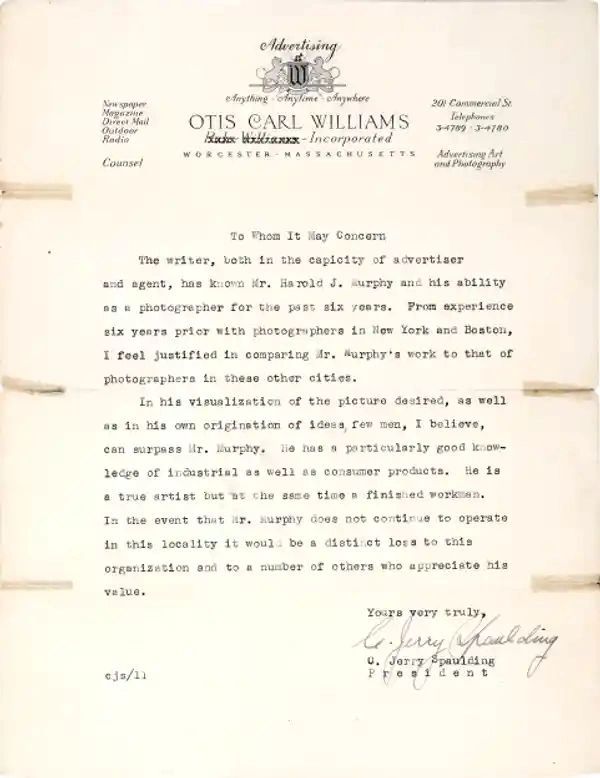
Otis Carl Williams - 1933
Many major advertisers of the time spoke highly of JH Murphy's works and referred to his works that few, if any, could ever create. Otis Carl Williams wrote,
"In his visualization of the picture desired, as well as in his own origination of ideas, few men, I believe, can surpass Mr. Murphy. He has a particularly good knowledge of industrial as well as consumer products. He is a true artist but at the same time a finished workman."
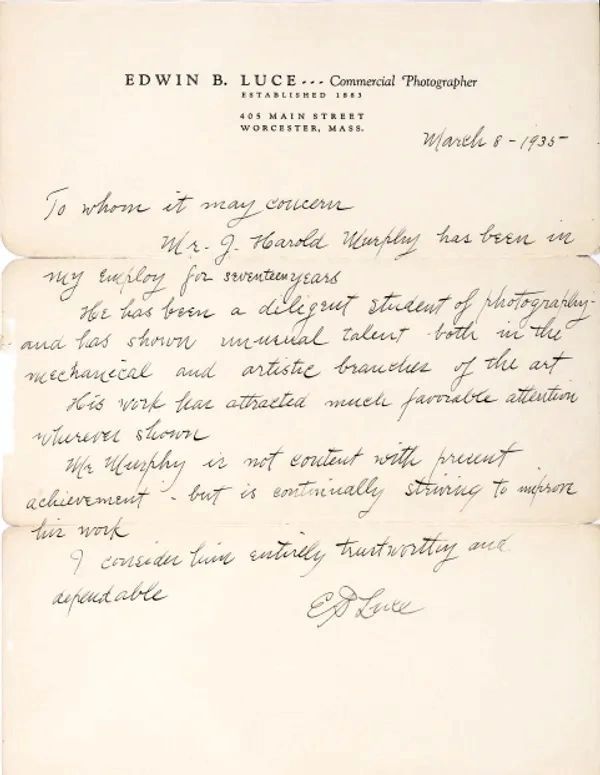
Edwin Bradbury Luce - 1935
JH Murphy studied under and worked for Edwin B. Luce for 17 years. Mr. Luce (ca. 1881–1938) was recognized as a pioneering photographer who specialized in portraiture, commercial, and industrial photography. Establishing one of the nation’s most successful and oldest commercial photography studios.
"... unusual talent both in the mechanical and artistic branches of the art. His work has attracted much favorable attention wherever shown"
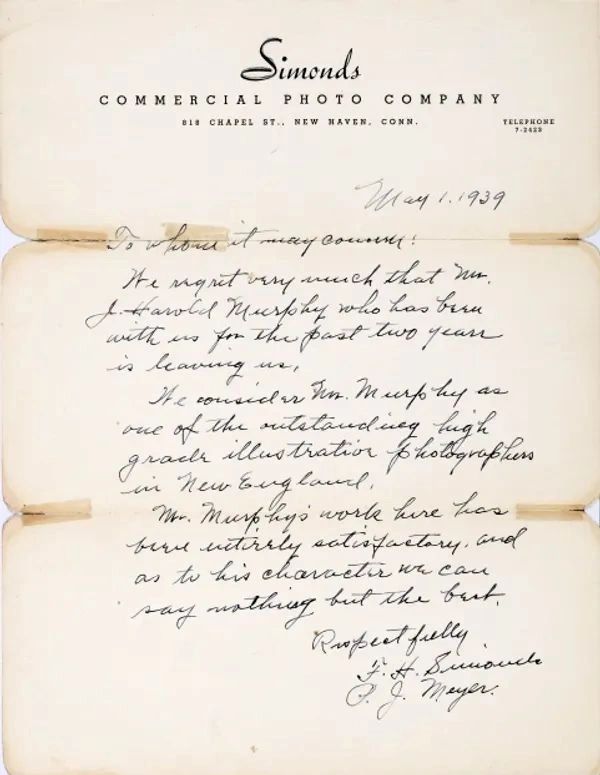
Simonds Photo Company - 1939
JH Murphy photographed for Simonds Commercial Photo Co. for several years. Simonds Commercial Photo Co. specialized in professional photography, particularly documenting architecture and institutional landmarks. The Library of Congress holds digital copies of some of Simonds’ photographs reflecting their work for institutional documentation.
"We consider Mr. Murphy as one of the outstanding high grade illustration photographers in New England."
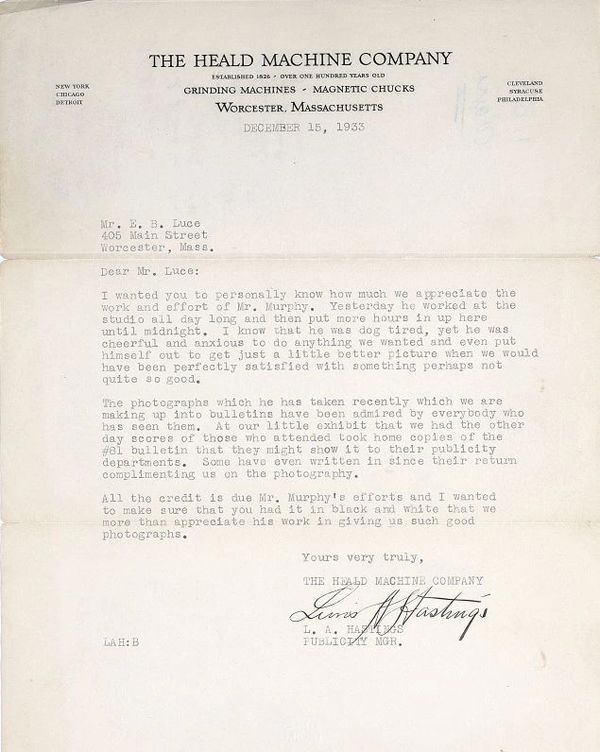
Heald Machine Company - 1933
This blacksmith shop, foundry, machine shop, and manufacturer traces its roots back to 1826. It was known as S. Heald & Sons. By 1899 they were known as L. S. Heald & Son. The name changed to Heald Machine Co in 1903. During the 20th century Heald was known for its machine tools, especially its grinders. From 1870 and through much of the 20th century they also made woodworking-related machinery, such as sawmills, and more.
"The photographs which he has taken recently have been admired by everybody ... All the credit is due Mr. Murphy's efforts ..."